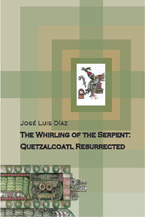
 The Whirling of the Serpent: Quetzalcoatl Resurrected
Author: José Luis Díaz
Publisher: Antares
Toronto, 2009
Review by Manuel Romero Mier y Terán
Being Mexican sometimes seems like an internal contradiction, as the vast majority of the Mexican population hold both the Spanish Conquistador and his indigenous victim in disdain. But this reality of our nation – which also resonates in other countries of Latin America – was not always the case. Before other chimeras like the Virgin of Guadalupe, China Poblana and the Mestizo, there was the Plumed Serpent, Lord of the Earth and Sky: Quetzalcoatl. He was a character that my generation learned about in history text books at elementary school as a god, priest or wise man who was expelled from his home after getting drunk on pulque, and who then departed on a boat of serpents promising he would return one day, thereby forging one of the most meaningful legends of Mexican psychological identity.
I remember that the information received about Quetzalcoatl in my school years was never complete; the door was always left open to further mysteries and questions. In my visits to archeological sites – Maya, Toltec, Teotihuacuano and Aztec – the Plumed Serpent was always the common denominator. But at the same time it seemed as if information on Quetzalcoatl was not in the public domain. A taboo imposed perhaps by the Christian churches in Mexico.
José Luis Díaz answered many of my questions with regard to this Mesoamerican deity in his book The Whirling of the Serpent: Quetzalcoatl Resurrected. The author, who is also a professor of neuroscience at the National Autonomous University of Mexico (UNAM), undertook the demanding task of compiling all the information (and interpretations of that information) available on the plumed serpent god, not only in the Mesoamerican context, but throughout Latin America. And in addition to this, he makes a bold proposal as to the role that Quetzalcoatl continues to play in the identity of modern Mexico. His book constitutes a journey through pre-Hispanic history that takes us to different regions of Latin America and into the pysche of Mexicans themselves. He reveals that the duality of Eagle and Serpent (like the Ying-Yang or the Abraxas of the Gnostic talismans) is no more than the representation of good and evil, or more precisely of the fear and longing that we hide in our collective subconscious.
It is worth noting that although this is a highly contentious topic, Dr. Díaz displays an impeccable methodology of research, compilation of archives and analysis, presenting historically documented evidence that reflects his scientific background. But this scientific approach does not conceal his humanistic, and, I would suggest, even philosophical sensibilities, as his work in this book constitutes a veritable “psychoanalysis” of the Mexico and Mesoamerica.
And what does he find hidden in the subconscious of the Mesoamerican peoples? The broken, torn, divided identity of Quetzalcoatl. It is an ambivalent identity revealed in previous essays on Mexico such as Octavio Paz’s The Labyrinth of Solitude and Samuel Ramos’s Profile of Man and Culture in Mexico. Diaz adds to this series of works the bipolarity of the winged serpent, who is visibly divided on the national coat of arms featured on the Mexican flag.
When we step into the realm of the psyche we are stepping onto thin ice and any position is unstable. Nevertheless, in the final chapters of his book Dr. Díaz invites us to reflect on the possible options that would lead to the reintegration of the opposites of quetzal (bird) and coatl (serpent). Will one of the two poles ever win the battle? Will the eagle devour the serpent, or vice versa? Will we have a nation united and ready to bury its past and live in the present with new ideas that point us toward the future? The question hangs in the air: Eagle or Serpent – coincidentally, the “heads” and “tails” of Mexican coins. This book, which is no less than a mirror on the Mexican spirit, leaves us reflecting on the need for a present in which, José Luis Díaz would argue, Quetzalcoatl inspires us through “the irrational precision of the parable”.
Translated by Martin Boyd
Manuel Romero Mier y Terán is a Mexican writer currently based in Toronto.