Martin Boyd
In Mexico City, we used to live in an apartment on Calle de la Higuera in the district of Coyoacán, a little street that ran between the bustle of the famous Plaza Hidalgo, with its myriad candy vendors, organ grinders and street comedians, and a peaceful, shady little park named “La Conchita”. Many a Sunday afternoon, to escape the madness in the centre of Coyoacán on the weekend – when the whole area filled with tourists who came to visit Frida Kahlo’s famous house, Casa Azul, or to buy souvenirs in the open-air market, or simply to soak up the atmosphere of one of the oldest districts of colonial Mexico City – Paulina and I would go and sit on one of the seats in La Conchita, to take refuge beside the little chapel there and breathe the almost soporific tranquility of that solemn place. On one occasion, while we sat contemplating the last rays of sunlight that filtered through the branches of one of the large old trees of the park, I imagined that I heard a faint voice in the whisper of the leaves, like the weeping of a woman in mourning. I turned around to look for the crying woman, but nobody was there. A moment later the sound stopped, and I was about to dismiss it as a product of my imagination when Paulina turned to me and asked me if I had heard a woman crying.
A few days later, I made mention of our experience to Don Hernán, a neighbour in our apartment complex who had lived more than fifty years in Coyoacán. He nodded and said to me with that frankness typical of Mexicans when they speak of metaphysical matters: “It was La Malinche that you heard.”
“La Malinche?”
“Yes, my friend. La Malinche was the lover of my namesake, the Spanish Conquistador Hernán Cortés, and the mother of the first Mexican “mestizo”, Martín Cortés. She lived her last years in a house there opposite La Conchita. It’s still there; you can see it – the big house on the corner of La Higuera where that painter lives. It was one of the first buildings in Coyoacán. And that’s where La Malinche lived with her little Martín. Then they took her son off to Spain, and La Malinche was left childless. That’s why she began to weep, and she weeps still, weeping for the son who was stolen from her. That’s why many people also call her “La Llorona”, the Weeping Woman. She was the one you heard.”
Don Hernán’s explanation surprised me. I knew the story of La Malinche well enough; she was a character who had intrigued me a great deal when I studied Mexican history before visiting Mexico for the first time. But I had never realized that I now lived in the same street where she had spent her last years. La Malinche was a young indigenous woman given to the Spanish Conquistador Hernán Cortés by the tribal lords of Tabasco. Her knowledge of the Aztec language, Nahuatl, won her the role of official interpreter between the Aztecs and the Spaniards. Nearly five centuries later, La Malinche is the archetypal symbol of treason against the Mexican fatherland, to such a degree that the derivative term “malinchismo” is an insult used to refer to any inclination to favour the foreign over the Mexican. She is the great traitor of Mexican history, the despicable woman who sold her homeland to the Spanish invaders. This is why there is no monument commemorating her role in the creation of Mexico, and her house in Coyoacán is merely another anonymous building.
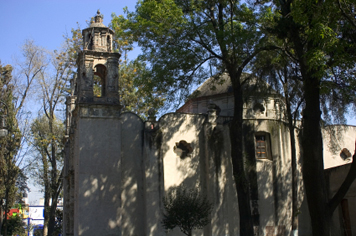
The chapel in the Parque de la Conchita, Coyoacán
When I asked Don Hernán why there was no plaque or monument to remind people of La Malinche’s presence in Coyoacán, a sad smile flickered across his face. “Because nobody wants to remember her,” he said. “In the eighties, when the city council built a fountain with a statue of Cortés and La Malinche and their son Martín, demonstrators gathered in protest, with placards reading “Out with the Traitor”. In the end, they had to pull down the statue because of the protests. Nobody in Mexico likes La Malinche.”
“No wonder she weeps,” I remarked in reply.
When I studied the details of her history, I wondered whether the charge of treason was just. La Malinche (or Doña Marina, as she is named by Bernal Díaz de Castillo (1492- c.1580) in his celebrated book The True History of the Conquest of New Spain), was born into a noble Mayan family in the Yucatán peninsula, who sold her into slavery after the death of her father. Because of her noble origins, she spoke Nahuatl, the official language of the Aztec Empire. The natives of Tabasco where she lived as a slave spoke only Mayan – the language of a subjugated people. The Tabascans, no doubt in the hope that the Spanish would liberate them from the oppression of Aztec imperialism, gave several slave women, including La Malinche, to Cortés and his crew as gifts. When Cortés realized that one of the slaves spoke the Aztec language, he gave her the job of interpreter. In the beginning, Doña Marina translated through the Spanish priest Gerónimo de Aguilar, who understood the Mayan language. But her facility with languages was so exceptional that she very quickly learned Spanish, and so soon became the direct interpreter between Cortés and the Aztec authorities. Evidently, her linguistic skills were not the only aspect of Doña Marina that impressed Hernán Cortés, as she bore him a son in 1523: Martín Cortés, who, as the first Mexican “mestizo” (of mixed Spanish and indigenous blood) should be recognized in Mexico as the father of the nation that supposedly celebrates its dual European-Amerindian heritage.
It seems obvious to me that La Malinche, being a slave, had no other option than to obey her masters, whether indigenous or Spanish. The alternative would have been death. And it is a reasonable conjecture that Doña Marina might have viewed the Spaniards just as many of the Amerindians subjugated by the Aztecs viewed them: as welcome allies who would help them to overthrow a brutal, oppressive empire. If only they had known that once the Aztec Empire was defeated, the Spanish Empire that would replace it would prove even more tyrannical than its predecessor.
The conversion of La Malinche into a figure of contempt is the result of the manipulation of her image during the war of Mexican independence in the 19th century, nearly three centuries after her life. The new nation needed a native mythology that rejected the influence of Spain. Although most of the independence leaders were “Criollos” (people of Spanish origin born in the Americas), it suited their purpose to claim indigenous culture as their own and to label the Spanish as foreign. In this context, La Malinche became the image par excellence of the traitor for having sided with the Spanish against her own people. The historical reality that “indigenous culture” in fact consisted of many different cultures was an inconvenient detail swept aside to achieve the new nation’s goals for social cohesion.
Two centuries later, La Malinche continues to be an anathema in the collective consciousness of the Mexican people. However, there are suggestions that her image may be rescued from the injustice it has suffered for two hundred years. In her new novel, La Malinche, Laura Esquivel gives Cortés’s interpreter the opportunity to tell the story of the Conquest from her own perspective, resulting in a more sympathetic depiction of the most maligned woman in Mexican history. But an image as deeply rooted as the great traitor won’t be changed overnight.
In the meantime, La Malinche goes on weeping in the park of La Conchita, that peaceful refuge a few steps from the beating heart of Coyoacán. She goes on weeping for the loss of her son, my namesake Martín, the forgotten father of the Mexican nation. And she goes on weeping for the nation that has condemned her to infamy for being no more than a woman with the grave misfortune of having a gift for languages.
Martin Boyd is a translator, writer and the director of Diálogos Intercultural Services.
Thank you so much for this story! I teach Jr. High social studies and this fits beautifully into one of our topics. This fills in some definite gaps.
I want the book you referenced and am going to research that now as well.