Martin Boyd
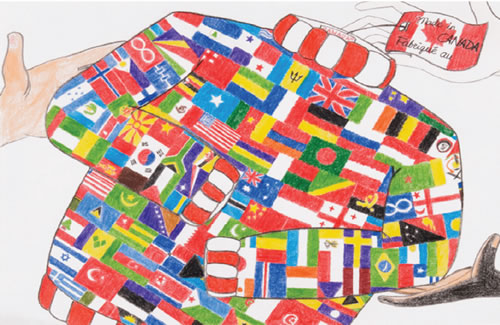 People often ask me about the “Intercultural” in the name of my company, Diálogos Intercultural Services. What does it mean exactly?
The short answer is that it refers euphemistically to translation. I am a translator and Diálogos is a translation company, and the services we provide are “intercultural” in the sense that they foster the communication of ideas and information between cultures. But on a deeper level, the concept of “interculturalism” effectively underpins my philosophy of translation and why I believe it is important, as it is through the intercultural communication facilitated by translation that people in different cultural contexts can come to understand, appreciate and learn from one another. Translation opens up the possibility of intercultural dialogues (hence the other component in the name of the company, Diálogos) that are mutually enriching for both cultures. And, I believe, it is only through such engagement with other cultures that we can ever hope to even begin to develop a more complete understanding of what it means to be human.
Canada is often identified as the original home of the concept of “multiculturalism”. The term was coined here in the 1960s in recognition of the country’s growing cultural diversity. While the notion of multiculturalism and the respect for diversity that underpins it are certainly positive, the concept has often been criticized for fostering cultural stratification and social fragmentation, as the different cultures coexisting in a supposedly pluralistic society may rarely interact. In recent years, an increasing number of authors examining the question have begun to propose the notion of “interculturalism” as an alternative. Notable among these is Mayte Gómez, who, in her brilliant analysis of Guillermo Verdecchia’s one-man play Fronteras Americanas, suggests that the Argentine-Canadian playwright’s exploration of the psychological borders separating Canadian society points to a conclusion that posits a new way of viewing the country’s multicultural mosaic:
“This is not simply multiculturalism, a notion which seems to imply static, unchanging cultures, living side by side without touching one another. Instead, it might be called interculturalism, as it is grounded on the interaction among living, practised cultures.”
This new alternative term to multiculturalism is not without its controversies; its adoption to describe official cultural policy in Quebec has already led to debate over the different shades of meaning of the concept. But for me at the heart of the notion of interculturalism is the “interaction” between cultures as described by Gómez. And Toronto, one of the most culturally diverse cities in the world and the birthplace of multiculturalism, is to my mind the perfect city for the ideal of interculturalism to be put into practice.
This idea of interculturalism is one of the underlying themes of my novel, Papalotero, which tells the story of Miguel Ángel, a young Mexican immigrant to Toronto who makes and flies kites for a living. In the novel I sought to explore the potential for intercultural interaction offered in a city as diverse as Toronto. Miguel Ángel’s chosen profession of kite-flying, which makes him stand out starkly in an orderly city of banks and big business, is a kind of metaphor for the condition of all immigrants, who never fully integrate into the new cultural context in which they find themselves. However, just as Miguel Ángel’s different way of looking at the world transforms the lives of those around him, it is the cultural difference of immigrants that constitutes their greatest potential contribution to the enrichment of their adopted home. For all of us to truly benefit from such potential, the necessary step needs to be made from multiculturalism, understood as a tolerance of diversity, to interculturalism, i.e., an embracing of diversity.
I would like to invite all Forum readers based in Toronto to take part in a conversation on the question of interculturalism at the Toronto book launch for Papalotero, to be held at Accents on Eglinton Bookstore at 7 p.m. on May 28. In addition to celebrating the recent publication of this intercultural love story, I hope it will be an opportunity to discuss ways in which we can move from merely tolerating diversity to truly embracing it.