Martin Boyd
Culture and language are inextricably linked, and the promotion of a culture necessarily entails the promotion of its language as well. In recent years, Spanish has come to occupy a high profile in North American pop culture; through the popularity of dance styles like Cuban salsa, Hispanic pop stars like Colombian singer Shakira, the novels of Isabel Allende or even the increasing interest in Mexican cuisine, North American mainstream culture has become peppered with spices from the Spanish-speaking world. While such aspects of Hispanic culture certainly have their intrinsic value, Hispanic culture has much more to offer, and there is an increasing number of Canadians (of both Hispanic and non-Hispanic backgrounds) who wish to explore this culture more deeply, and to gain a true appreciation of the richness of the language in which literary icons such as Sor Juana, Federico García Lorca, Jorge Luís Borges and Pablo Neruda wrote their works. The Cultural Celebration of the Spanish Language (or CCIE, its Spanish acronym) is one of very few organizations in Canada that are dedicated to providing opportunities to those people interested in learning more about Hispanic literature, art, music and film than they can obtain from the superficial (and often stereotypical) images available to them through mainstream media.
The CCIE is a non-profit initiative that began life in 1992, as part of the activities commemorating the 500th anniversary of the arrival of Christopher Columbus in the Americas. Since then, under the direction of Argentine-Canadian poet and university professor Margarita Feliciano, this organization has become one of Toronto’s most important promoters of literature, film and music in the Spanish language, as well as of Spanish-English and Spanish-French literary translation.
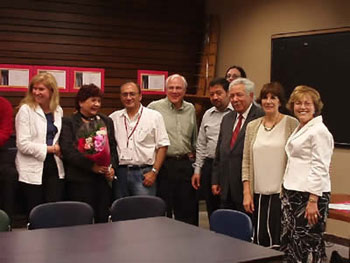 The organization is made up entirely of volunteers – some of whom have been contributing to its activities since its inception in 1992 – and it has worked closely with numerous academic institutions in Toronto, particularly York University’s Glendon College, where the organization is based, which has been a major sponsor of the organization’s events over the years. It has also had the support of the ten Spanish-speaking consulates in Toronto, all of whom are deemed CCIE members “ex oficio”. Over the years the nature of this support has evolved and changed together with the relationships between the Hispanic consulates themselves; in the early years, consular support of CCIE initiatives was organized under a coordinating body of Latin American consulates, while more recently the various consulates have become increasingly inclined towards working independently of one another. This trend is perhaps logical given the growth of the Hispanic community in Canada in recent years, which has given some consulates a large enough local community to work individually to promote their own events without the support of the consular network. On the other hand, the disintegration of the spirit of solidarity between Spanish-speaking consulates in Toronto raises new challenges for organizations like the CCIE, whose purpose in promoting the Spanish language naturally seeks to bring together the various Spanish-speaking communities in Toronto in recognition and celebration of their common linguistic heritage.
Many of the events organized by the CCIE are coordinated under the umbrella of the Festival of Images and Words, which generally takes place in the months of September and October each year. This festival offers a wide gamut of Spanish-speaking events open to the Toronto public, including a film festival, art exhibitions, concerts, theatrical performances, book launches, literary readings, literary contests, and panel discussions on a broad variety of topics ranging from discussions of language as a vehicle for social bonding to the historical significance of indigenous Mexican cuisine.
This year’s festival, going by the title En Alas de la Creatividad Hispana (”On the Wings of Hispanic Creativity”), began on September 27th with the opening of the four-day Sí-Sí Cine Film Festival, which, having celebrated its 17th consecutive year in 2008, is the longest running Spanish-language film festival in the city. In recent years, the films presented have included works by some of the world’s most outstanding directors, including Argentina’s Alejandro Agresti (Valentín, 2004), and Chile’s Rodrigo Sepúlveda (Padre Nuestro, 2005), and has also provided the only opportunity for Toronto audiences to view high-quality documentaries dealing with various aspects of Hispanic history and culture, such as last year’s presentations of A Promise to the Dead, the chronicle of Chile’s 1973 military coup from the perspective of President Allende’s former cultural advisor Ariel Dorfman, and Sefarad – Caminos y Vida, a film tracing the history and legacy of the Judeo-Spanish-speaking Sephardic community in Spain. This year’s edition of Sí-Sí Cine featured several award-winning films by promising new Hispanic directors, including Andrés Wood’s Machuca (winner of the Most Popular International Film Award at the Vancouver Film Festival in 2004), and Voces Inocentes by Mexico’s Luis Mandoki, which won three Ariel Awards (Mexico’s equivalent of the Oscar) in 2005.
Another event falling under the “images” component of this year’s festival of words and images was the opening on October 3 of the exhibition “Universo Antillano”, displaying the work of Dominican painter Willy Pérez, whose vibrant paintings invite us into the colourful world of his Caribbean homeland. The opening, held at the Columbus Centre’s Joseph D. Carrier Gallery at Dufferin and Lawrence, also offered the public a sampling of Latin American classical music under the direction of pianist Antonio Fernández. As part of the “Words” component of this year’s festival, the CCIE sponsored the awards ceremony for the “nuestra palabra” Short Story Competition on October 8, and also held an evening of readings by local authors writing in Spanish on October 16, both events taking place at the Columbus Centre.
Another important CCIE initiative has been the creation of its own publishing house, the Antares Publishing House of Spanish Culture, founded in 2006, which launched its first publication in February of this year – the tri-lingual poetry collection La Palabra Ardiente / La Parole Ardente / The Ardent Word by Mexican poet Francisco Azuela. The imprint’s second publication is Canada and the Americas: Multidisciplinary Perspectives on Transculturality, a collection of articles on issues related to translation and intercultural relations on the American continent (or continents, depending on your point of view), which will be launched at Glendon College on the evening of October 31st, at the closing event of this year’s Festival of Images and Words. In fact, the closing ceremony will include a multiple book launch, as the new bilingual poetry collection by CCIE President Margarita Feliciano, El Portal de la Sirena / The Mermaid’s Gateway y De Viajes y Rodajes / Break-In Voyage, published by the Ottawa-based Spanish language publishing house Split Quotation/La Cita Trunca, will also be launched on this evening.
Outside the festival itself, the CCIE has also organized conferences and workshops focusing on Spanish language and literature. The literary workshops offered in recent years have examined literary theory, Spanish works in translation, recurrent themes in Hispanic literature and creative writing in Spanish. These workshops have been mostly attended by Hispanic Canadians, although non-Hispanics with an interest in Spanish have also taken part
One of the challenges faced by the CCIE in promoting its activities has been reaching a broader public beyond academic circles. Although the support that the organization has received from university bodies has been fundamental to its continued existence, audiences at many CCIE events have often been largely limited to university students and faculty members, particularly in the case of those events that have been held on university campuses. CCIE president Margarita Feliciano says that the organization desires to encourage the participation of the broader community, which has motivated them to begin seeking venues for their events off university campuses, such as the Columbus Centre, and to publicize the events through more non-academic media sources, such as the popular “Toronto Hispano” website.
The CCIE also seeks to encourage non-Hispanic communities to participate in its events, as the organization’s mission is to stimulate and promote mutual appreciation and awareness of the artistic contributions made by Hispanic Canadians and other Canadians of different origins. The aim is to create opportunities for dialogue between cultures, to exchange ideas and, as the name of the organization suggests, to celebrate the world of creative wealth that each culture – and each language associated with it – has to offer.
For more information about the CCIE, please contact Margarita Feliciano at (416) 487 6787 or by email at [email protected] or visit the CCIE website.
Any volunteer opportunities with u in the near future