Martin Boyd
According to statistics published by the Print Measurement Bureau (www.pmb.ca), there are now more than 900,000 Hispanics living in Canada. Other sources put the figure at over 1 million. Although this figure looks insignificant against the 45 million people of Hispanic origin living in the United States, it represents a huge increase in numbers over the past decade, and this population explosion is reflected in the increasing number of Hispanic institutions in Canada’s major urban centres – particularly in the Greater Toronto Area, where the majority of Canada’s Hispanics live (according to a Statistics Canada study conducted in 2008).
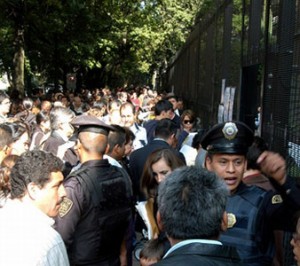
Chaos outside the Canadian Embassy in Mexico following the flash announcement of the visa requirement.
Hispanics and Hispanic culture are making an increasing impact on the Canadian cultural landscape, and there has been evidence to suggest that this impact is increasing awareness and appreciation of Latin America in Canada, a country which historically has had virtually no relationship with the Spanish-speaking world. In July 2007, when Stephen Harper made his first tour of Latin America as Canadian prime minister, he described the region as part of Canada’s “neighbourhood”, and expressed the Canadian government’s commitment to foster ties with the region. The Canadian government has since made some significant moves to develop a closer relationship with Latin America, and particularly with Mexico, although this relationship was dealt a tragic blow this summer with the sudden announcement to impose visa restrictions on Mexican nationals. This decision, which was an ill-conceived knee-jerk reaction to the high proportion of rejected refugee claims coming from Mexico in recent years, was announced with virtually no advance warning – even to the Canadian Embassy in Mexico, which was clearly unprepared to deal with the sudden flood of visa applications. There is no doubt that the decision will severely reduce the number of Mexican tourists who choose Canada as a destination (260,000 in 2008, according to some sources) and will therefore represent a substantial loss for the Canadian tourist industry. Canada’s image in Mexico has also clearly been affected, and Canada-Mexico business relations will inevitably suffer as a result. The Canadian government justifies the decision on the basis of 8,500 rejected refugee claims from Mexico in 2008, but even the Immigration Minister, Jason Kenney, has admitted that the introduction of the visa requirement does not really address the root problem – Canada’s refugee claimant screening process, which indiscriminately grants refugee claimant status to virtually anyone who requests it, only to reject them a year and thousands of dollars later when it has been determined that they do not meet the definition of refugees. The blunder represents a regrettable step backwards in the development of our relationship with our Mexican neighbours.
Here in Canada itself, Hispanics face some challenges in their efforts to gain recognition in the Canadian multicultural mosaic. A report issued in April this year by the Association for Canadian Studies revealed the shocking data that on average Hispanic males earn 46% less than English- and French-Canadian males, and that Hispanics rank among the lowest income earners in the country. The figures reflect the difficult and often desperate conditions under which many Latin Americans arrive in this country, but also point to some serious flaws in the supposedly immigrant-friendly Canadian workforce to integrate its newest arrivals.
It’s clear that Canada still has a long way to go to fulfill the promise of its government to foster closer ties with our Latino neighbours, both in Latin America and here in Canada.