A Comic Look at the Two Mexicos

Nosotros los Nobles
Director: Gaz Alazraki
Studio: Alazraki Films
Mexico, 2013

Review by Martin Boyd

It is no secret to most Mexicans that the central issue underlying all the turmoil that has affected their country in recent years – from the violence of the so-called “drug war” to the teacher protests that have brought Mexico City to a standstill on several occasions this year – is the growing gap between rich and poor. The Mexican economy has expanded considerably in recent decades to turn the country into one of the world’s economic superpowers; nevertheless, only a select group of Mexicans have benefited from the revenues earned from the country’s increasing productivity. Mexico’s economic inequality has led many commentators to speak of the emergence of “two Mexicos”, “one that is the beneficiary of neoliberal globalization, and the other that receives scarcely a few drops of the wealth that is created” (Agustín Basave, El Universal).

Continue reading

Translating Latin America, Part 4: Magical Realism

Martin Boyd

Juan Rulfo, the legendary Mexican author whose English translators have been unable to do him justice.

In Part 3 of my series of articles on translating Latin America, I explored the phenomenon of the so-called Latin American literary boom that began in the 1960s. This “boom” has been closely associated with the genre of “magical realism”, characterized in the English-speaking world as the Latin American literary mode par excellence. According to Sylvia Molloy, althoug it is not so much a Latin American invention as a “transculturation” of French symbolism, magical realism was singled out by US readers to signify, “as surely as Carmen Miranda’s fruity cornucopias, ‘Latin America’”, thereby becoming a “regional, ethnicized commodity”, a form of “essentialized primitivism” (374) that reinforces preexisting stereotypes of Latin America as a magical territory, beyond the reaches of civilization, where the laws of science and reason do not apply. Molloy suggests that “[m]agic realism is refulgent, amusing, and kitschy,” but the reality it describes “doesn’t happen, couldn’t happen, here [in the United States]” (375). Unfortunately, the author adds, the fact that only a small number of Latin American authors comfortably fit the magical realist mould has condemned much Latin American literature to the “ever-expanding purgatory of the untranslatable” (375)… unless the work can be “rewritten” to fit into the genre, as seems to be the case of Mexican author Juan Rulfo’s Pedro Páramo, a novel which is surely one of the greatest literary works of the twentieth century, but whose two English translations have failed to convey the simultaneously Gothic and realist tone of the original.

Continue reading

In the Name of the Son

Mario Huacuja

One of the most striking memories of my early childhood is that of my encounter with the Statue of Liberty. I would have been four or five years old, and the sight of it filled me with awe; I had never seen a woman so big. Everything about her was larger than life. Her green copper colour, the strength of her arm raised to the sky, the elegance of her tunic, the golden flame of her torch and her vacant expression marked me forever. It was as if the world had been arranged to bring about that moment; my mother and I had boarded the ferry at Battery Park after walking around the walls of Clinton Castle, and I had barely begun to rock with the waves in one of the ferry’s indoor seats when sleep overtook me. On waking, before I’d completely shaken off my slumber, the Statue loomed over me with all the force of her two hundred and twenty tons, and as my bewildered eyes passed over her figure I couldn’t decide whether she was the colossal virgin of a Catholic church or a petrified monster that had escaped from my worst nightmares.

Continue reading

Finding Translation

Martin Boyd

“Giants” (Gary Willis, 1992)

In 1992, a friend gave me a copy of Gabriel García Márquez’s One Hundred Years of Solitude. It was the first work of Hispanic literature I ever read, and it opened me up to a world that appeared more vital and powerful than anything I had ever encountered before. At the time, I was sharing a house in London with an artist who was working on a series of paintings featuring Don Quixote, and thus the tragicomic exploits of Spain’s mythical knight errant were combined in my imagination with the singular history of Macondo, both narratives inviting me into the vast, labyrinthine dominions of the Spanish-speaking world.

Continue reading

Martín Agonía

Songs

The Mexican poet Martin Agonía was born in 1969 in Ecatepec de Morelos, in the State of Mexico. He has been living in Toronto for 10 years. His past experiences and his experiences as an immigrant have shaped his literary work, which is marked by social critique and a blunt description of the reality of many foreigners living in one of the most developed cities in the world. His writings have been published in the anthology Iguana, escribir el exilio (White Dwarf, 2007) and in his poetry collection La Tolvanera (2012).

Continue reading

We are Quetzalcoatl

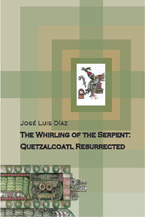
The Whirling of the Serpent José Luis DíazThe Whirling of the Serpent: Quetzalcoatl Resurrected
Author: José Luis Díaz
Publisher: Antares
Toronto, 2009

Review by Manuel Romero Mier y Terán

Being Mexican sometimes seems like an internal contradiction, as the vast majority of the Mexican population hold both the Spanish Conquistador and his indigenous victim in disdain. But this reality of our nation – which also resonates in other countries of Latin America – was not always the case. Before other chimeras like the Virgin of Guadalupe, China Poblana and the Mestizo, there was the Plumed Serpent, Lord of the Earth and Sky: Quetzalcoatl. He was a character that my generation learned about in history text books at elementary school as a god, priest or wise man who was expelled from his home after getting drunk on pulque, and who then departed on a boat of serpents promising he would return one day, thereby forging one of the most meaningful legends of Mexican psychological identity.

Continue reading

Two Opposing Views of Literary Translation: Nabokov vs. Borges

Martin Boyd

The idea that a translation should be a faithful representation of the source text is a widely accepted truism that few would think to question. It is a concept that has guided most writing about translation for the past two thousand years, as debates in translation studies have tended to revolve around questions of the best methods for achieving “faithful” representation, whether it be St. Jerome’s idea of “sense for sense” translation, or Schleiermacher’s recommendation of a “foreignizing” technique; only in a few rare cases has the debate turned to whether such “faithful” representation is even possible… or desirable.

Continue reading

Tania Hernández Cervantes

I Want to Live

Tania Hernández Cervantes is a Mexican writer currently living in Toronto, where she is completing a doctorate in environmental studies at York University. Her poem “I Want to Live” is a homage to Marisela Escobedo, murdered on December 16, 2010 in Ciudad Juárez for calling for justice in the case of her daughter, Rubí, after the decision of a Mexican court that released her killer in spite of the evidence against him, including a confession in open court. The case of Marisela and her daughter is one of the many tragedies resulting from the violence against women in Ciudad Juárez and the impunity currently afflicting the Mexican justice system.

Continue reading

Keep Hope Alive

Martha Bátiz and Martin Boyd at the book launch for “Papalotero”

A heartfelt thank you to all who attended the book launch for my novel Papalotero at Accents Bookstore, this week. For those who missed it, an excerpt from the presentation on the novel by Mexican-Canadian writer Martha Bátiz is included below. – Martin Boyd

Continue reading

Interculturalism

Martin Boyd

People often ask me about the “Intercultural” in the name of my company, Diálogos Intercultural Services. What does it mean exactly?

The short answer is that it refers euphemistically to translation. I am a translator and Diálogos is a translation company, and the services we provide are “intercultural” in the sense that they foster the communication of ideas and information between cultures. But on a deeper level, the concept of “interculturalism” effectively underpins my philosophy of translation and why I believe it is important, as it is through the intercultural communication facilitated by translation that people in different cultural contexts can come to understand, appreciate and learn from one another. Translation opens up the possibility of intercultural dialogues (hence the other component in the name of the company, Diálogos) that are mutually enriching for both cultures. And, I believe, it is only through such engagement with other cultures that we can ever hope to even begin to develop a more complete understanding of what it means to be human.

Continue reading